
AI didn't kill content marketing. It killed promotional content.
Everyone can generate “5 reasons to buy our product” in 30 seconds. Everyone sounds the same now.

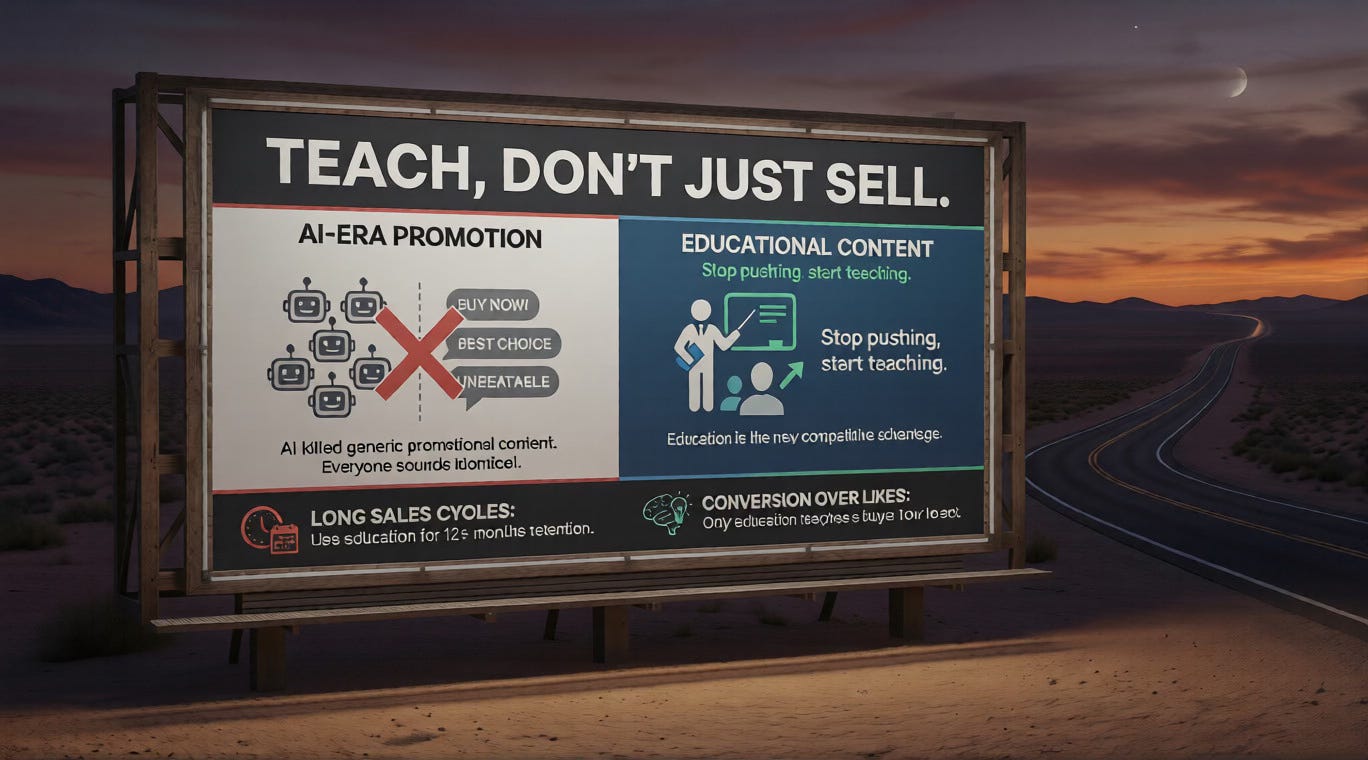
Educational content is the new way to stand out.
But not every company needs to make this change. Some can still win with promotional content
This week I broke down why educational content matters and how Educational Email Courses work.
Today I’m sharing how to know which approach you need.
Three signals you need educational content
Signal 1: Your sales cycles are long
If your buyers need 6 to 12 months to decide, promotional content won’t carry you. They’ll forget you by month 3.
Educational content keeps you top of mind. Each piece builds understanding. By month 12, you’re the obvious choice because you’ve been teaching them all along.
Signal 2: Your product requires buyer education
If prospects don’t understand the problem you solve, promotional content fails. They can’t see why they need you.
This happens a lot in technical sectors. AI platforms. Cybersecurity tools. New category products.
Educational content teaches them to recognise their problem first. Then shows them how to evaluate solutions. You’re shaping how they think before they ever talk to sales.
Signal 3: Good engagement, zero conversions
Your posts get likes. Your emails get opens. But nobody’s buying.
That’s the gap between entertainment and education.
Entertainment gets engagement. Education gets conversions.
If people enjoy your content but don’t act on it, you’re not educating. You’re just being interesting.
What educational content actually means
Not just “helpful tips.” That’s still surface level.
Educational content teaches buyers how to think about their problem. It builds frameworks they can use. It creates diagnostic tools.
And most importantly, prospects feel they’re getting real value. They’re learning something useful. They appreciate being educated rather than sold to. That appreciation builds trust faster than any sales pitch.
Examples:
• Educational email courses (5 to 7 day learning journeys)
• In-depth buyer’s guides
• Diagnostic assessments
• Problem-first content (educate on the issue before mentioning your solution)
The difference:
Promotional content says “We’re the best choice.”
Educational content says “Here’s how to choose.”
One pushes. One teaches. One leaves prospects feeling sold to. The other leaves them feeling smarter.
How AI fits into this
AI can speed up educational content creation. But only if you have an education-first strategy.
Using AI to outline a 5-day email course on “How to evaluate AI security vendors”? Smart.
Using AI to write another “10 tips for AI adoption” post? You’re part of the noise.
AI amplifies your approach. If your approach is promotional spam, you’ll just create more spam faster.
If your approach is education, AI helps you scale teaching.
Where to start
Map your buyer’s learning journey.
What do they need to understand before they can buy from you?
Most technical companies skip this step. They jump straight to “here’s what we built.”
But buyers need context first:
• Why does this problem matter?
• What are my options?
• How do I evaluate those options?
• What should I look for?
Once you map that journey, create one educational asset. Start small.
A 3-email mini-course beats nothing.
Test it. See who completes it. Talk to them. Refine.
Then use AI to scale what works.
When promotional content still works
Not everyone needs educational content. The depth of education you need depends on your sales cycle and product complexity.
Short sales cycles (under 30 days)
Buyers can decide quickly, but that doesn’t mean zero education. Even fast buyers need to understand what they’re buying.
Light education works: Quick guides, comparison charts, brief explainers.
Deep education courses might be overkill. But some education still matters.
Simple products
If buyers immediately understand what you do and why they need it, heavy education isn’t necessary.
But “simple” doesn’t mean “no explanation needed.” Most technical products need some level of education.
Mature markets
Buyers already know the problem and the solutions. They’re just comparing vendors.
Education shifts to differentiation: Why your approach? What makes you different? How do you think about the problem differently?
Different sales cycles need different education levels:
• 30-day cycle: Brief guides and quick wins
• 90-day cycle: Email mini-courses (3 to 5 emails)
• 6 to 12 month cycle: Full educational programmes with multiple touchpoints
The question isn’t “Do I need education or promotion?”
The question is “How much education does my buyer need before they’re ready to decide?”
The bottom line
AI killed promotional content for technical companies with long sales cycles.
Everyone can create it now. It’s no longer a differentiator.
Educational content is what survives. But only if you actually educate, not just entertain.
I help technical companies build these educational systems. If you’re thinking about making this change, reply to this email. I’d love to hear what you’re working on.
—Pushvinder