
The Complete Funnel Framework
How highly anticipated a product launch can fail. Discover the strategy that works.

I once watched a product launch fail spectacularly.
Brilliant product. Real innovation. Would’ve helped customers massively.
But sales went silent for months.
The problem? It wasn’t the product. It was four connected funnel mistakes happening at once.
Today, I’m giving you the complete framework for fixing them.
Because here’s the thing: most technical funnels aren’t broken in one place. They’re broken at every stage. And patching one leak whilst ignoring the others won’t save the ship.
You need an integrated approach. Here’s how to build it.
The Four Problems (Quick Recap)
Before we fix them, let’s be clear about what we’re fixing:
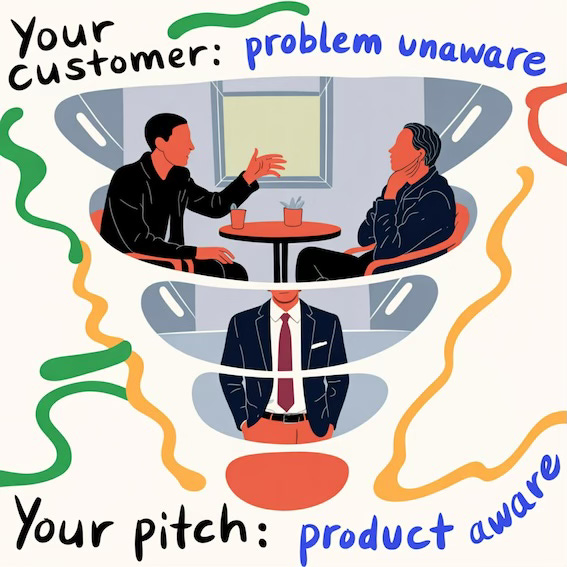
Problem 1: Skipping awareness stages. You’re selling solutions to problems buyers don’t know they have.
Problem 2: Wrong language at each stage. Technical jargon at awareness, feature lists at consideration, specs at decision—none of it connects.
Problem 3: Binary thinking. You’re treating content and conversions as competing priorities instead of integrated strategy.
Problem 4: Unclear messaging. Your homepage answers “what we built” but not “what changes for you.”
These aren’t separate issues. They’re symptoms of building for the demo, not the journey.
Here’s how to fix all four.
The Integrated Funnel Framework
Stop thinking about your funnel as separate stages you optimise independently. Think of it as one continuous journey with different content needs at each point.
Top of Funnel: Build Awareness of the Problem
This is where most technical companies fail. They skip straight to product messaging because they can’t imagine buyers don’t see the problem.
What to do:
Educate on the problem before you mention your solution. Show buyers what’s broken, what’s at risk, or what’s possible. Use thought leadership, industry trends, and problem-focused content.
Example: Instead of “Our AI detects threats faster,” write about “Why traditional security tools miss 40% of insider threats.”
Success looks like: Buyers start saying “I didn’t realise this was an issue” or “I thought we were the only ones dealing with this.”
Middle of Funnel: Shift from Problems to Outcomes
Once buyers understand the problem, they need to know solutions exist—and what those solutions deliver.
This is where you translate technical depth into buyer language. Not features. Outcomes.
What to do:
Show what changes when the problem is solved. Use case studies, comparison content, and outcome-focused messaging. Frame everything in terms buyers care about: reduced risk, speed, visibility, confidence.
Example: Not “ML-powered behavioural analytics,” but “You’ll spot problems before they hit the news.”
Success looks like: Buyers asking “How does this work?” instead of “Why do I need this?”
Bottom of Funnel: Connect Specs to Real Impact
By the time buyers reach decision stage, they need technical validation. But they also need to see how your specs translate to their specific situation.
What to do:
Provide the technical detail—but always connect it to business outcomes. Answer: What does this protect? How does it make my life easier? Why should I trust you?
Use demos, technical documentation, and proof points. But frame them around the buyer’s reality, not your architecture.
Example: Not just “99.9% uptime,” but “Your traders execute faster. You’ll never miss another audit.”
Success looks like: Qualified prospects booking calls and coming prepared with specific questions.
The Integration Strategy: How These Work Together
Here’s the crucial part: these stages don’t work in isolation.
Your awareness content should naturally lead to consideration content. Your consideration content should make decision-stage conversations easier. And your bottom-funnel tactics should feed insights back into top-funnel messaging.
This means:
→ Blog posts about industry problems link to solution comparison guides
→ Case studies highlight outcomes, then offer demos for technical deep-dives
→ Sales conversations reveal customer objections that become awareness content
→ Demo requests trigger email sequences that nurture over 6-12 months
It’s not content OR conversions. It’s content AND conversions, working as one system.
Timeline Expectations: This Takes Time
I need to be honest about something: even when you fix your strategy, results won’t be instant.
That product launch I mentioned? After we rebuilt the funnel properly—integrating awareness, consideration, and decision content—it still took months to see traction.
Because awareness building is slow work. You’re changing how buyers think about a problem. That doesn’t happen in a week.
What success looks like before sales appear:
→ Higher engagement from your ideal customer profile
→ More inbound questions and connection requests
→ Longer time spent on key pages
→ Prospects saying “I’ve been following your content for months”
These are leading indicators. Trust them.
The Diagnostic: Where to Start
If you’re looking at this framework and thinking “We’re broken everywhere,” here’s where to start:
• If prospects say “I’m not sure I need this” → Start with awareness content
• If your homepage reads like a spec sheet → Fix your language problem
• If leadership debates “content or conversions” → Build the integrated strategy
• If qualified prospects ghost → Clarify your messaging
Fix the biggest leak first. Then move to the next one.
The Bottom Line
You can’t force buyers through a funnel they’re not ready for.
If they don’t know the problem exists, they won’t care about your solution. If they can’t understand your messaging, they won’t engage. If you’re only focused on short-term conversions, you’ll miss the long-term pipeline.
Build for the journey, not just the demo.
Integrate awareness, consideration, and decision content into one system. Speak the right language at each stage. Balance short-term tactics with long-term trust-building.
It takes time. But it works.
And when it does, you’ll stop chasing demos and start fielding inbound from buyers who already understand the problem, already see the value, and are ready to move forward.
That’s when funnels start working.
—Pushvinder